| Voltages used for titanium Color: Copper - 11v PurpleTitanium - 23v Blue Titanium - 31.8v Yellow Titanium - 51v Gold Titanium - 65.3v Pink Titanium - 81v Green titanium - 102.6v |
| Prices for titanium color includes your entire order. Only for items purchased in store. If you would only like part of the order anodized please make sure you let me know at payment. |
| Returns of Anodized Titanium |
| Unforturnatly I cannot return color titanium unless there is an actual problem with the part. Once the part is colored I cannot reverse it. Please make sure your item is the correct for your application. I offer coloring as a customer service and do my best but also can't return for shading problems. |
| Can you make Titanium Black or Red? |
| The titanium coloring process is not a dye process like aluminum. Titanium coloring is an effect of light refraction and true red is not possible. Black is a special process and I will be bringing in some black titanium bolts over time. |
| Anodizing Aluminum and Titanium Color FAQ's |
| Do you do your own anodizing? |
| All the TorontoCycles items are anodized in house, Pulleys, most aluminum bolts, derailleur bolts...will be done here by me. Titanium coloring is also done here. Anodizing is a process I am always trying to improve as well, I have not been able to find an anodizer capable of some colors (Pink in particular) or need too high of a stock of any given color. |
| What else can you make in Pink? |
| Any item I sell can be made to pink if you can wait a few days for me to complete the process. In some cases I will have to add a few dollars depending on the item. Pink is a harder color for me to make. |
| Are there shades of anodized colors? |
| I will have more information with regards to colors on the titanium anodizing and aluminum anodizing pages. |
| Can you anodize a part I have? |
| I will anodize some parts. There is a fee involved. Please check out my aluminum anodizing page and email me with details of your project. |
Anodizing titanium generates an array of different titanium color without dyes, for which it is sometimes used in art, costume jewelry, body piercing jewellery and wedding rings. The color formed is dependent on the thickness of the oxide (which is determined by the anodising voltage); it is caused by the interference of light reflecting off the oxide surface with light traveling through it and reflecting off the underlying metal surface. Titanium nitride coatings can also be formed, which have a brown or golden color and have the same wear and corrosion benefits as anodization. |
| Titanium Anodizing is one of the more environmentally-friendly metal finishing processes. Titanium color is produced with no waste product. |


| Add Gold Titanium Color to Your Entire Order For $2.00 |
| Add Blue Titanium Color to Your Entire Order For $2.00 |
| Add Green Titanium Color to Your Entire Order For $4.00 |
| Add Pink Titanium Color to Your Entire Order For $4.00 |
| Add Brown Titanium Color to Your Entire Order For $2.00 |


| Titanium Anodizing, Titanium Color, Anodized Bicycle Bolts |
Titanium color chart voltage
| Hope our Titanium Anodizing page helps. Check out our blog for more Titanium Color |
| Shipping Information Please check out FAQ page or Blog for shipping rates and information. |
| Please Note that Tracking From Canada is Costly and Extra Charges Apply |
| All Prices are in US Dollar $5.00 Shipping via Air Mail Tracking is extra Costs! |
| Some browsers like FireFox and Opera may not operate properly with checkout. If the cart button is missing then I am out of that item |
| Please refresh browsers (F5 Key) as I update this website daily |

| Below is a sample of a new process we have for gun metal grey titanium anodizing. |
| Gun Metal Titanium Color to Your Entire Order For $2.00 |
| Several titanium colors are available that titanium anodizing can be applied. Titanium color is produced by light refraction and interference of wavelengths. The film thickness is very thin and can actually be polished out with a commercial Steel polish. The anodized layer is durable though, it takes heavy polish and rubbing to remove. Etching will also enhance color but dulls shine. It's impossible for me to exact match other colored titanium or anodized aluminum. Green Titanium Anodizing: Green titanium anodizing is a special process and an additional charge applies. The color is a high voltage (110-120v). Green titanium can be very difficult and some larger parts will not achieve the color. I have been asked about the process and sorry that I can't release many details. Black Titanium Anodizing: Black titanium is a special process and is not done in house. Vacuum Deposition is the process used to coat the bolts. Black titanium is very durable and will not fade or chip. Red Titanium Anodizing: There is no true red titanium. Pink vs. Purple Titanium Anodizing: There is some discrepancy on Pink and Purple Colors. Purple is quite dark and when wet can look brown, which is the color with the lower voltage. Purple can also be difficult to make because it's a narrow voltage band. A few volts less and it's brown. A few more and its blue. Dark Purple also smears and isn't the best color. Pink is a high voltage color and is also a different process. It's not true pink and some customers will say its purple. This is not the case. In the store pink is also lavender. Blue Titanium Anodizing: Blue is about the easiest color to make. I have a process that will make the color deeper though. Dark and light is the only real difference. Lighter blue is also called "electric blue". Gold Titanium Anodizing: Gold is higher voltages. At the peak the color can swing into a nasty pinkish on it's way to pink. Therefore gold can only be so dark before this happens. We avoid this thru careful voltage control. Gun Metal Grey Color: I can produce this color and is a special process. Also, a brownish titanium can be produced In Store Anodize (Titanium Color) I've been getting more requests to bring in ti to color. Recently knife owners have been coming in for this process. There will be a $10.00 charge for titanium anodize for non-purchased items. Green and Pink are $20.00 depending on the item(s). These 2 colors are much more difficult and I cannot guarantee on items other than what I have here. Some notes on this: 1. There is a $10.00 fee. 2. The titanium MUST be totally grease and oil free. 3. The ti cannot be mounted to steel or any other metal. 4. Larger titanium stock has to be brush plated, color can vary a bit on this process and isnt totally steady. Please contact me on this. 5. I'm not charging per item but cannot be a crazy amount of items either. Mailing in Titanium to Anodize: I am accepting titanium to anodize for the same rates as above. Shipping return costs are not included. Please contact Tom at Sales@torontocycles.com for more information and mailing instructions. How do I know it's Titanium? I have had a few customers that have brought me items to anodize and when I saw the item I told them it's not titanium. Of course they asked how do you know? I answered I just know which isn't really that helpful. Here's a few tips on how to tell if it's ti and not aluminum,stainless or other metals. 1. Titanium is tough. It will not scratch that easy and aluminum will. Most aluminum you can scuff with you fingernail if pressed hard. 2. Acid will not bother it as it's a non-reactive metal. 3. Titanium will not stick to a magnet. 4. Titanium can dull and become grey which can make you think its steel. Most titanium will polish well. 5. Titanium will anodize 6. Ti is half the weight of steel and a bit heavier than aluminum. 7. My own personal test is Smell. Ti will not smell like metal when rubbed. As I have found out by sorting bolts for hours there is no smell. All other base metals will smell. Work with steel tools for a while and you can smell the metal. rub coins or copper or even stainless and you can smell it on your fingers. 8. Titanium can be made into a variety of color. Hope this helps and if you have other tips please comment! |
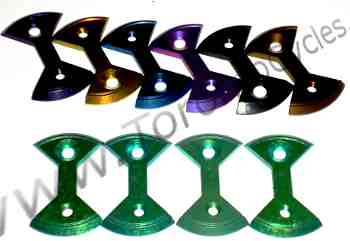

| Titanium anodizing can produce several colors. Titanium color is produced by light refraction and interference of wavelengths. It's impossible for me to exact match other colored titanium or anodized aluminum. Green anodized titanium color and lavender (Pink) titanium is a special process and and additional charge applies. Green titanium anodizing can be very difficult and some larger parts will not achieve the color. I can advise on this. Black titanium is a special process and is not done in house. |