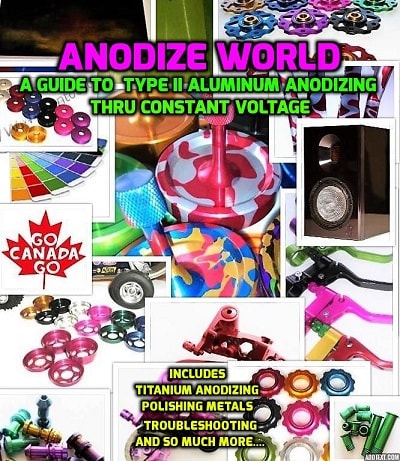
There is a fee of 25.00 for anodizing and return shipping with a trace of 15.00 (USA)
I can do most colors. One thing to note is sometimes I cannot guarantee finish on all
items but usually have good success.
Please let me know what you might have and the metal needs to be cleaned or I will
have to strip it and will take time.
History of Anodizing
Anodizing was first used on an industrial scale in 1923 to protect Duralumin seaplane parts from corrosion. This early chromic acid
process was called the Bengough-Stuart process and was documented in British defence specification DEF STAN 03-24/3. It is still
used today despite its legacy requirements for a complicated voltage cycle now known to be unnecessary. Variations of this process
soon evolved, and the first sulfuric acid anodizing process was patented by Gower and O'Brien in 1927. Sulfuric acid soon became
and remains the most common anodizing electrolyte.[1]

Oxalic acid anodizing was first patented in Japan in 1923 and later widely used in Germany, particularly for architectural applications.
Anodized aluminium extrusion was a popular architectural material in the 1960s and 1970s, but has since been displaced by cheaper
plastics and powdercoating.[2] The phosphoric acid processes are the most recent major development, so far only used as
pretreatments for adhesives or organic paints.[1] A wide variety of proprietary and increasingly complex variations of all these
anodizing processes continue to be developed by industry, so the growing trend in military and industrial standards is to classify by
coating properties rather than by process chemistry.

Anodized aluminium
Aluminium alloys are anodized to increase corrosion resistance, to increase surface hardness, and to allow dyeing (coloring),
improved lubrication, or improved adhesion. The anodic layer is non-conductive.[3]

When exposed to air at room temperature, or any other gas containing oxygen, pure aluminium self-passivates by forming a surface
layer of amorphous aluminium oxide 2 to 3 nm thick,[4] which provides very effective protection against corrosion. Aluminium alloys
typically form a thicker oxide layer, 5-15 nm thick, but tend to be more susceptible to corrosion. Aluminium alloy parts are anodized to
greatly increase the thickness of this layer for corrosion resistance. The corrosion resistance of aluminium alloys is significantly
decreased by certain alloying elements or impurities: copper, iron, and silicon,[5] so 2000, 4000, and 6000-series alloys tend to be
most susceptible. Some aluminium aircraft parts, architectural materials, and consumer products are anodized. Anodized aluminium
can be found on mp3 players, flashlights, cookware, cameras, sporting goods, window frames, roofs, in electrolytic capacitors, and
on many other products both for corrosion resistance and the ability to retain dye. Although anodizing only has moderate wear
resistance, the deeper pores can better retain a lubricating film than a smooth surface would.

Anodized coatings have a much lower thermal conductivity and coefficient of linear expansion than aluminium. As a result, the
coating will crack from thermal stress if exposed to temperatures above 80 °C. The coating can crack, but it will not peel.[6] The
melting point of aluminium oxide is 2050 °C, much higher than pure aluminium's 658 °C.[6] (This can make welding more difficult.) In
typical commercial aluminium anodization processes, the aluminium oxide is grown down into the surface and out from the surface by
equal amounts. So anodizing will increase the part dimensions on each surface by half of the oxide thickness. For example a coating
that is (2 μm) thick, will increase the part dimensions by (1 μm) per surface. If the part is anodized on all sides, then all linear
dimensions will increase by the oxide thickness. Anodized aluminium surfaces are harder than aluminium but have low to moderate
wear resistance, although this can be improved with thickness and sealing.

Process
Preceding the anodization process, wrought alloys are cleaned in either a hot soak cleaner or in a solvent bath and may be etched in
sodium hydroxide (normally with added sodium gluconate), ammonium bifluoride or brightened in a mix of acids. Cast alloys are
normally best just cleaned due to the presence of intermetallic substances unless they are a high purity alloy such as LM0.

The anodized aluminium layer is grown by passing a direct current through an electrolytic solution, with the aluminium object serving
as the anode (the positive electrode). The current releases hydrogen at the cathode (the negative electrode) and oxygen at the
surface of the aluminium anode, creating a build-up of aluminium oxide. Alternating current and pulsed current is also possible but
rarely used. The voltage required by various solutions may range from 1 to 300 V DC, although most fall in the range of 15 to 21 V.
Higher voltages are typically required for thicker coatings formed in sulfuric and organic acid. The anodizing current varies with the
area of aluminium being anodized, and typically ranges from 0.3 to 3 amperes of current per square decimeter (20 to 200 mA/in²).

Aluminium anodizing is usually performed in an acid solution which slowly dissolves the aluminium oxide. The acid action is balanced
with the oxidation rate to form a coating with nanopores, 10-150 nm in diameter.[6] These pores are what allows the electrolyte
solution and current to reach the aluminium substrate and continue growing the coating to greater thickness beyond what is
produced by autopassivation.[7] However, these same pores will later permit air or water to reach the substrate and initiate corrosion
if not sealed. They are often filled with colored dyes and/or corrosion inhibitors before sealing. Because the dye is only superficial,
the underlying oxide may continue to provide corrosion protection even if minor wear and scratches may break through the dyed
layer.

Conditions such as electrolyte concentration, acidity, solution temperature, and current must be controlled to allow the formation of a
consistent oxide layer. Harder, thicker films tend to be produced by more dilute solutions at lower temperatures with higher voltages
and currents. The film thickness can range from under 0.5 micrometers for bright decorative work up to 150 micrometers for
architectural applications.

The most widely used anodizing specification, MIL-A-8625, defines three types of aluminium anodization. Type I is Chromic Acid
Anodization, Type II is Sulfuric Acid Anodization and Type III is sulfuric acid hardcoat anodization. Other anodizing specifications
include MIL-A-63576, AMS 2469, AMS 2470, AMS 2471, AMS 2472, AMS 2482, ASTM B580, ASTM D3933, ISO 10074 and BS 5599.
AMS 2468 is obsolete. None of these specifications define a detailed process or chemistry, but rather a set of tests and quality
assurance measures which the anodized product must meet. BS 1615 provides guidance in the selection of alloys for anodizing. For
British defence work, a detailed chromic and sulfuric anodizing processes are described by DEF STAN 03-24/3 and DEF STAN 03-
25/3 respectively.
www.torontocycles.com
$5.00 Shipping
Aluminum Anodizing
_______________________________________________
Home Page
Aluminum Nuts & Bolts
Aluminum Hardware
American - USA
Titanium Nuts & Bolts
Bar and Grip
Brake Levers
Brakes / Rotors
Brake Adapters
Cages
Clothing
Derailleurs
Headset / Spacer
Hubs / Skewers
Pedal and Cranks
Seat / Post / Clamp
Titanium Nuts & Bolts
Titanium Hardware
Miniature Bolts
Pads / Shoes
Sale Items / Last Chance
Titanium Camping Gear
Tools
Paypal, Credit Cards and Checks Accepted
Orders ship for 5.00 via Air Mail
We ship Worldwide.
All Prices are USD
Contact Us
Frequently Asked
Questions
Warranty and Return
Dealers
Shipping and Payment
Titanium Anodizing
How To Measure Bolts
Aluminum Anodizing
Customer Photos
Payment for Special
Orders
Add Tracking to your
Order:
Canada = 8.00


USA = 12.00


International = 40.00